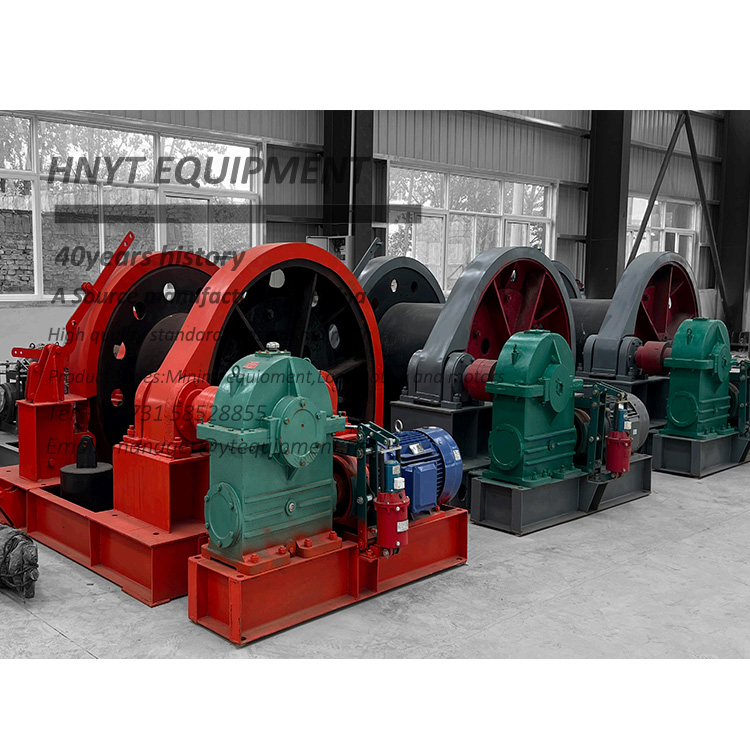
When deciding how to choose a mining winch, match the shaft arrangement and lifting duty first, then check rope limits, speed, braking and installation. A mining hoist winch should be selected for a defined task; the series name alone does not establish that a particular model suits the job.
State whether the equipment will work on the surface or underground, and identify the mine type or engineering application. Specify a vertical or inclined shaft, single-hook or double-hook operation, and the lifting distance and load. These conditions establish which hoisting arrangements to consider.
Identify the conveyance: skip, cage, tub train, or cage with an ore car. Give the roadway width and height, and distinguish material transport from personnel lifting. Ask the supplier to confirm the configuration for that service, including any explosion-proof requirement.
JKM/JKMD: Multi-rope friction hoists for vertical shafts. JKM uses a tower arrangement, while JKMD is ground mounted. Consider this family when the planned shaft system calls for multi-rope friction hoisting.
JK(B)/2JK(B): Single-rope winding hoists for vertical or inclined shaft duties. Specify the required drum and hook arrangement with the enquiry; confirm the model against the lifting task and mechanical limits.
JTP(B)/2JTP(B): Winding winches with single- or double-drum arrangements for inclined roadways and small shafts. The range includes variable-frequency speed control and PLC control; confirm the scope supplied with the proposed model.
JTK/2JTK: Single-rope winding winches for inclined roadways and small vertical shafts. The published series description identifies block brakes, a depth indicator and a reducer. Compare these features with the control and braking arrangement required for the project.
JZ/JKZ: Review the shaft-sinking range when the task is suspending excavation equipment, such as platforms, pumps or grouting pipes. Define the suspension or lifting duty before treating this family as an alternative to a production mine hoist.
Ask for separate checks of maximum static rope tension and, where applicable, static tension difference. Confirm the wire-rope diameter and breaking force against the proposed model's requirements. A payload figure by itself does not confirm all of these selection conditions.
For a winding hoist, check that rope capacity covers the required lifting distance with the specified rope and winding arrangement. State the required operating speed and confirm that it does not exceed the selected hoist's maximum. Keep these checks tied to the same model and configuration.
The published JKM/JKMD, JK(B)/2JK(B) and JTP descriptions identify disc brakes with hydraulic systems. The JTK description identifies block brakes. For the JZ/JKZ sinking range, the overview describes a spring-applied working brake and a weight-operated safety brake.
Request the working and safety braking details for the offered unit, including its response to loss of power. Where depth indication, overwind protection or PLC control is described, have the supplier identify what is included. A feature listed for a range should be checked against the actual supply configuration.
Provide the supply voltage and the distance from the winch house to the transformer for the electrical selection. Confirm whether the motor and reducer must sit on the left or right of the main unit. Include roadway dimensions in the layout review so the proposed arrangement addresses the site's installation conditions.
No. Rope tension, tension difference where relevant, rope specification, rope capacity and speed must also match the duty. Braking, controls and installation still need confirmation.
Their published descriptions differ: JTP uses disc brakes, while JTK uses block brakes. Ask for the braking and safety configuration of the specific unit being offered.
For help with how to choose a mining winch, send HNYT your shaft and conveyance arrangement, lifting distance and load, required speed, power supply details and site layout. These inputs allow a proposed series and model to be checked against your operating conditions.
←How to Choose a Pneumatic Rock Loader for an Underground Heading?
No Information→